Register
Made objects
Questions it asks
Applying: a tool that helps a person see and shape the cooking practice they already have.
Surfacing: a kitchen, as a techno-living space, made legible to the person inhabiting it.
Stage
Active
Years
2026–ongoing
Place
Personal project
Role
Designer & developer
The encounter
Hundreds recipes, and no tool that fit
Cooking is a practice worth getting better at. For several years the recipes lived on a Trello board, 274 of them, scattered across lists, their ingredients buried in free-form descriptions and their categories stuck behind labels built for project management rather than meal planning. Trello did what it could, but the friction was real every time a recipe had to be used in the kitchen. The deeper problem: the kitchen is the space I most directly inhabit as a learner, and the tool for navigating it had no relationship to anything else around it. A kitchen becomes a techno-living space through the technologies its inhabitant brings into it. This kitchen was mine; the technology had to become mine too.
What was made
A kitchen notebook that cooks
Food Baby is a local web app, designed and built to live alongside an existing Obsidian vault of recipes. Each recipe is one Markdown file with structured metadata. Obsidian remains a first-class editor on laptop and phone; Food Baby is the cooking-side surface that sits over the same files. The app does six things, all of them in service of actually cooking:
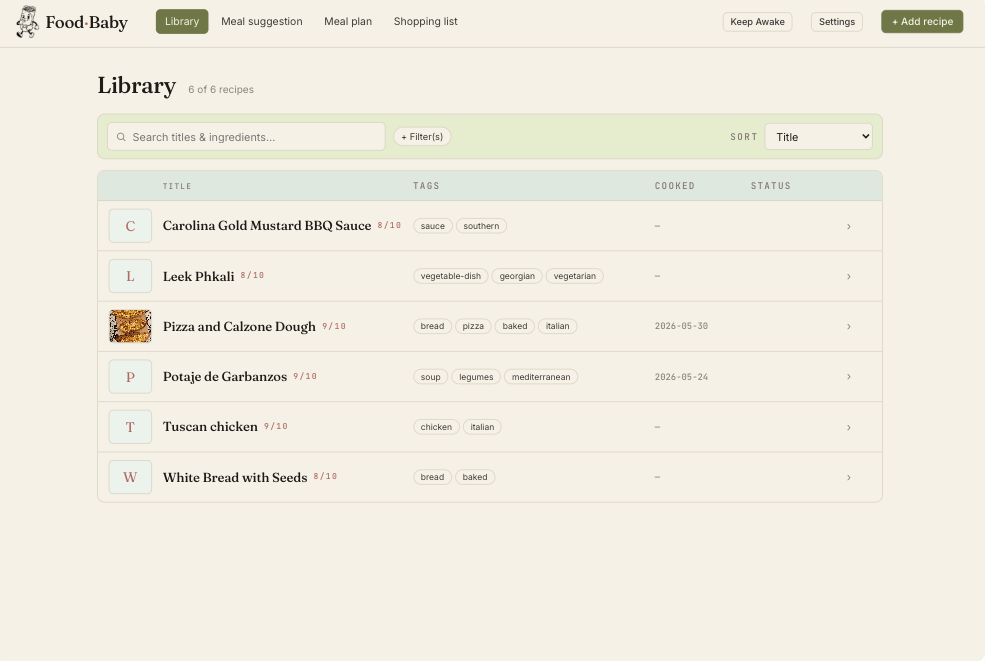
- Browse and search a recipe library by title and by ingredient, with multi-select tag filters across cuisines, categories, and meal contexts.
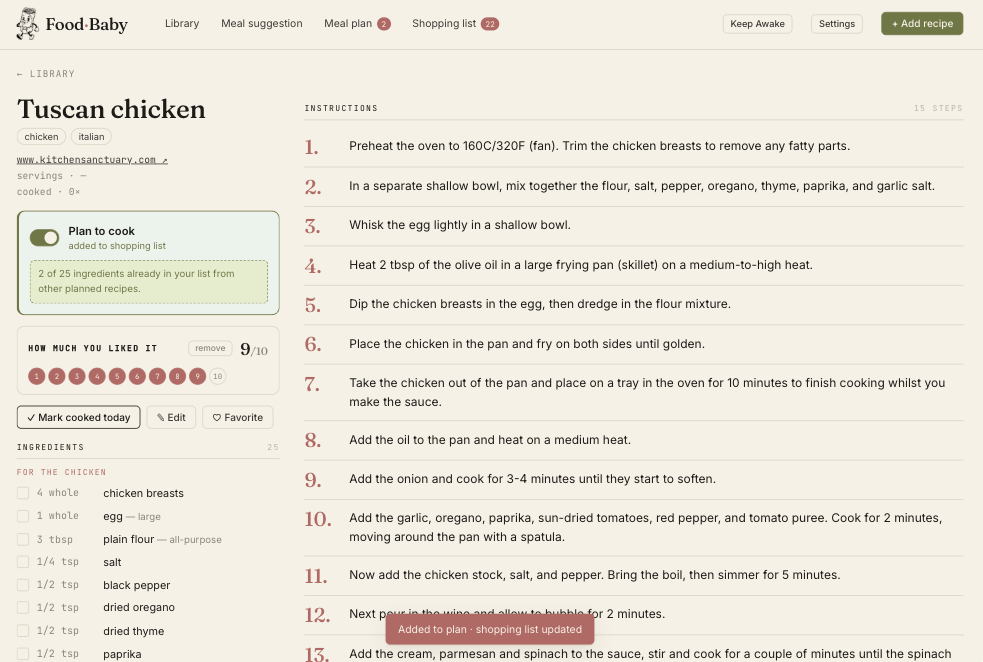
- Read a recipe in the kitchen in a layout that respects the rhythm of cooking: sticky ingredients on the left, generously spaced numbered steps on the right, type sized to read from across the counter.
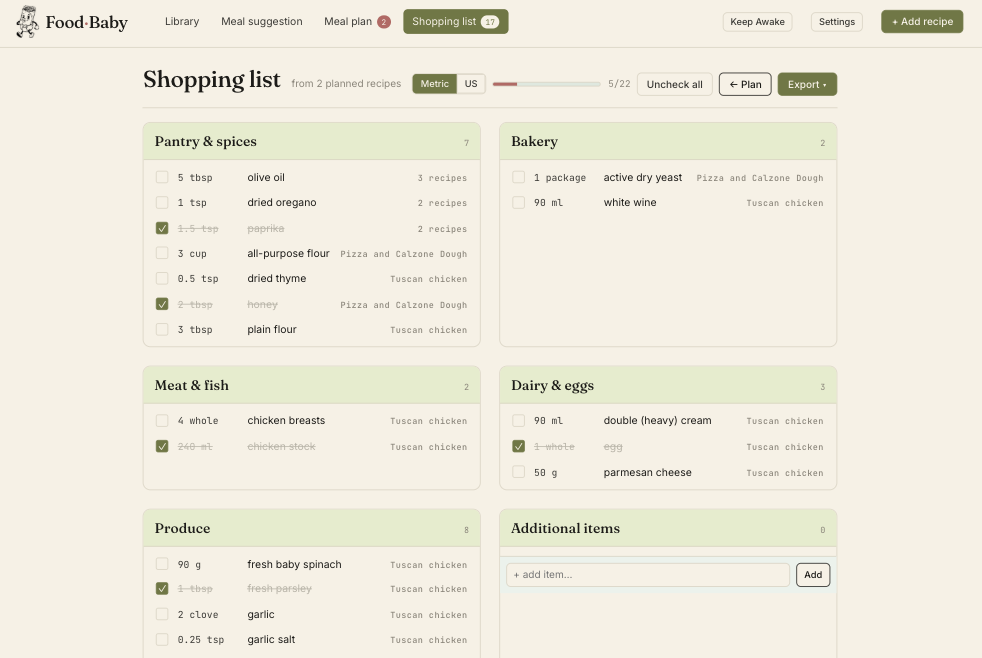
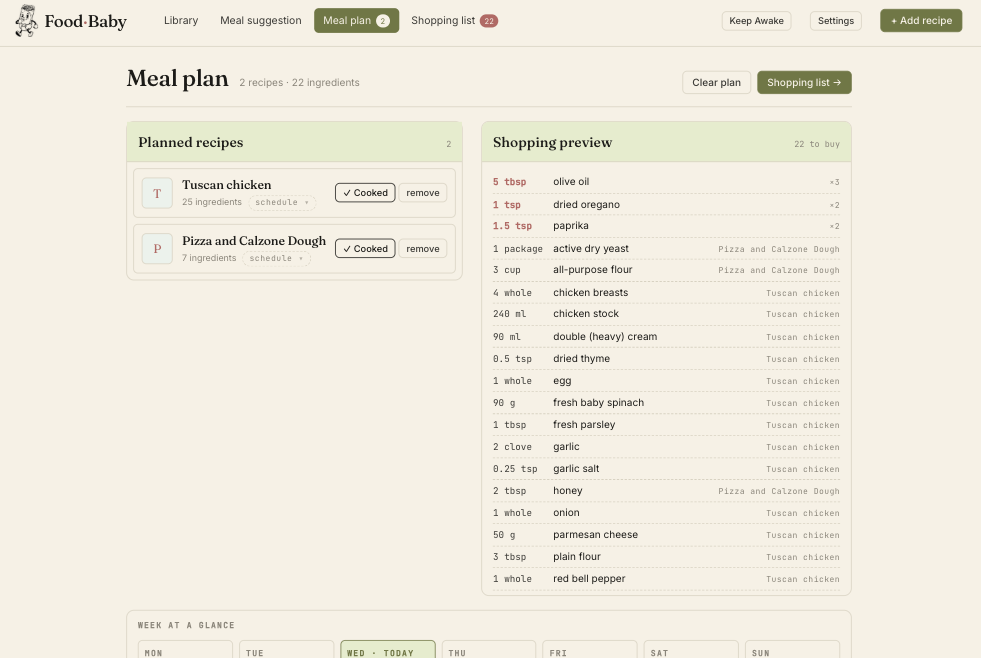
- Plan meals by toggling recipes into a current plan.
- Generate a shopping list automatically from the planned recipes, ingredients aggregated where their units match, attributed back to their source recipes, check-off state preserved across new plans.
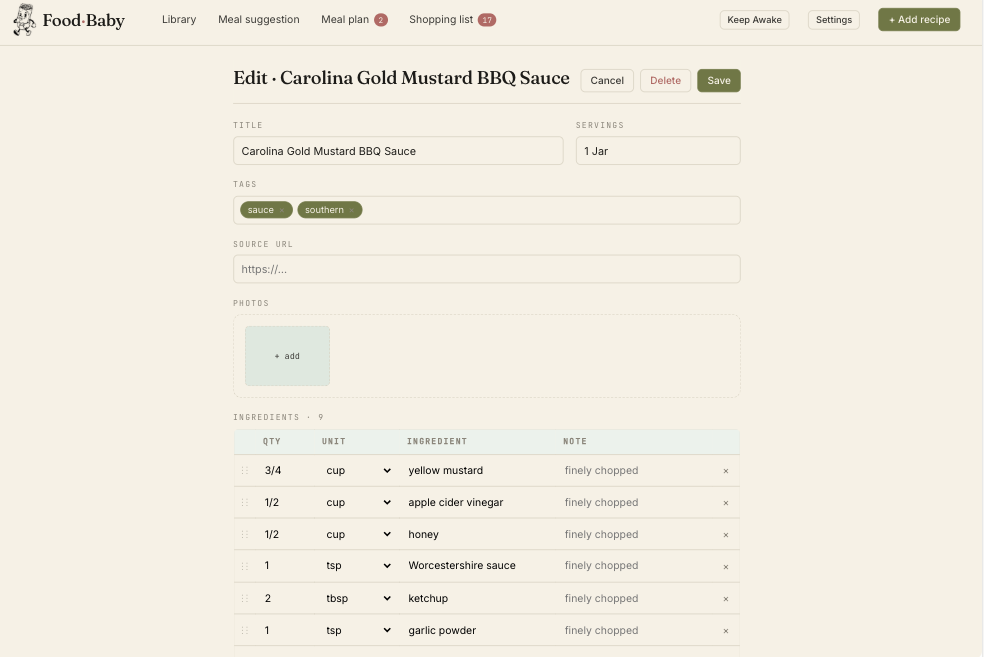
- Edit and add recipes through a form-based interface that never exposes raw YAML or Markdown syntax.
- Migrate the existing Trello library through a one-shot import that parsed all 274 cards into structured Markdown, with a report flagging anything needing a manual spot-check.
The visual register is intentional. The app should feel like a well-organised kitchen notebook: a warm paper-and-ink palette, a serif typeface for the recipes themselves, restrained editorial design you would want to spend time inside while cooking, not a tech-y dashboard. The recipes sit on the page as quiet objects, available to be cooked.
What it shows
Inhabited as a kitchen, not a database
Food Baby belongs with Georgian Scholar: both are designed artefacts built for use within my own living space, here to make an everyday practice easier to keep and to grow, not research outputs. It does not test the thesis; it carries a background in semiotics and techno-living spaces into the ordinary work of cooking well. That shows in what the small affordances are for. A meal-plan toggle, an aggregated shopping list, a search that surfaces the salad last made when guests stayed over: these are not productivity features but the means by which a cook notices the practice already underway and chooses what to do next. A kitchen becomes a cooking kitchen not by being one, but by being inhabited as one, with the right artefacts at hand.
Built and run locally; not deployed publicly
Backed by an Obsidian vault of ~292 recipes (274 originally migrated from a personal Trello workspace, plus additions since)
Walkthrough available on request
Background informing the build: semiotics and a specialization in techno-living spaces (doctoral research, University of Tartu)
Food Baby · a personal project · Semiozic OÜ