Register
Made objects
Questions it asks
Surfacing: seeing the algorithmic codes that quietly shape what we find.
Applying: a tool that helps a group encounter and reshape its relation to digital platforms.
Stage
Active
Years
2022 (prototype) / 2026 (AI interface)
Place
Semiozic project
Role
Designer
The encounter
Slowed down by a deck of cards
Algorithmic search shapes what we find before we have noticed there was a choice. The codes are not hidden; they are simply too quick and too smooth to register as codes at all. Most responses to this condition are essays, talks, or apps that put a single user in front of an interface. BTA was made for the opposite situation: a group of people in a room together, slowed down by a deck of cards and a question that has no obvious search query.
It began as a self-initiated test of my doctoral research, specifically the work on de-sign (intentionality carried across the making of things) and techno-living spaces (the digitally mediated environments where everyday life now unfolds). The aim was to see whether that theory could produce a working artefact that lived in a real room, not only in a thesis chapter. BTA is the answer to that question.
What was made
Two materialities, one diagnostic
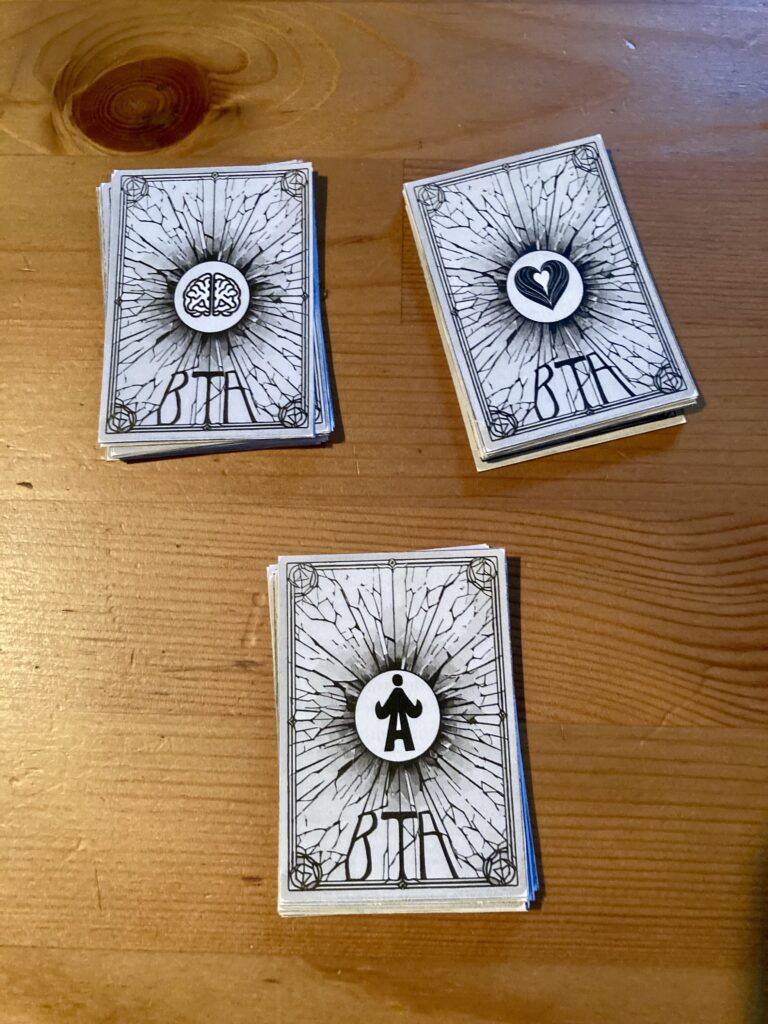
The card game (2022, in-house prototype) organises questions into three categories (Mind, Heart, Body), each opening a different register of attention:
- Mind holds dialogical imagination: questions that move across past, present, future, and the imaginative (how a historical event still shapes a current platform; what a technology might look like ten years from now).
- Heart holds the present register of integrity and passion: honesty, transparency, and what one actually cares about beyond what is shareable.
- Body holds the physical, present act: surroundings, time, embodied attention, and the digital footprint a body leaves while searching.
Play proceeds slowly and collectively. Players draw a card, contemplate the question, and respond beyond a single sentence. The group then searches together, reading results out loud, discussing what appears, and reaching consensus on what is worth following. Insights collect into a shared folder that builds across rounds, so the game produces a navigable record of what the group discovered rather than a winner.
The AI interface (2026, runs locally) carries the same diagnostic into an AI-mediated environment. The Mind / Heart / Body categories persist; the questions persist; the slowing-down persists. What changes is the surface the group is navigating: no longer a search engine but a conversation with an AI that itself runs on algorithmic patterning. The two versions are siblings: same intent, two distinct semiotic environments, and the migration from paper to AI is part of the project’s argument.
What it shows
The proof is the translation
BTA does not critique algorithmic mediation from the outside. It hands a group of people a structured way to encounter that mediation together, slowly enough to see it. The fact that it now exists in both printed and AI form is the proof of its design logic: the diagnostic is robust enough to survive translation across material registers, which is itself the kind of de-sign claim the project was making in the first place.
AI interface: currently in revision; walkthrough available on request
Card prototype: in-house, 2022
Presented academically as “Break the Algorithm: How a card game can de-sign meaning in a living space” at the 13th Conference of the Nordic Association for Semiotic Studies (Feeling, Skill, Knowledge), Helsinki, June 2023
Break the Algorithm · a Semiozic project