Register
Made spaces & encounters
Questions it asks
Bridging: keeping a curatorial argument intact as it crosses between Estonian and English.
Surfacing: reading the singular, hand-made qualities no symbolic example can stand in for.
Stage
Completed
Years
2023
Place
Estonian National Museum (ERM), Tartu
Role
Curatorial collaborator
The encounter
The forest answers, the source speaks
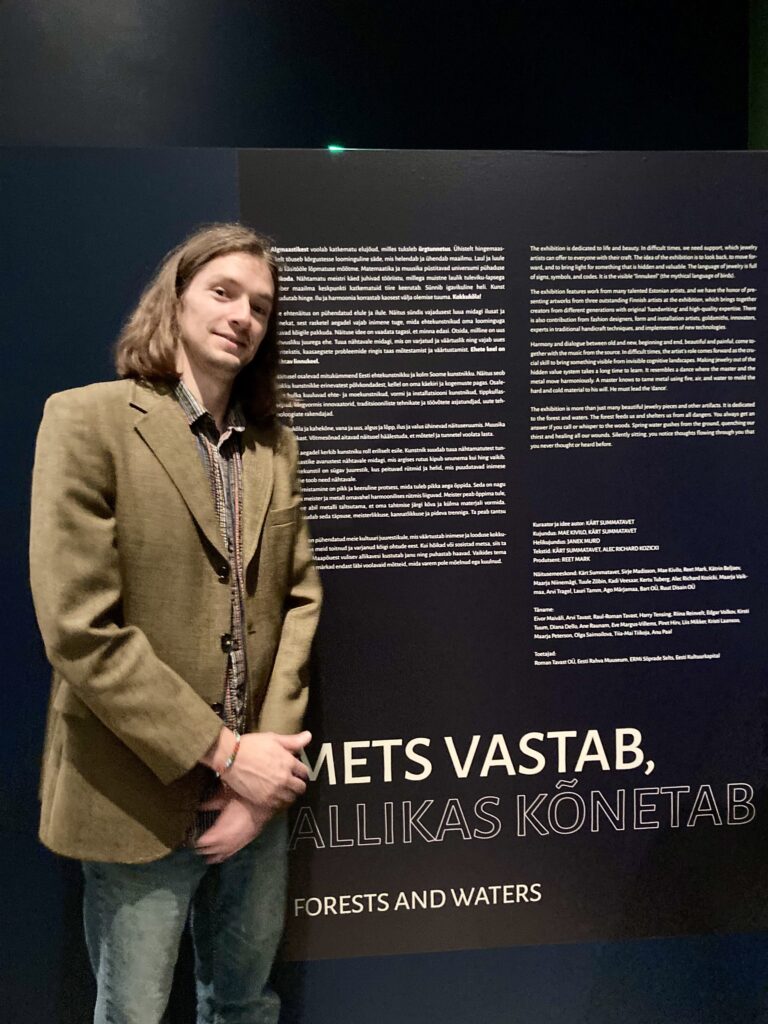
On 20 October 2023, the Estonian National Museum in Tartu opened Mets vastab, allikas kõnetab, exhibited in English as Forests and Waters, an exhibition of Estonian jewelry from ancient times to the present, curated by Kärt Summatavet. The Estonian renders more literally as the forest answers, the source speaks, and in that literal form it is already an argument: that the meaning carried by these objects is not exhausted by their material or their period, but resonates with the forest and the spring that the wearer’s culture has been in conversation with for centuries. The collaboration with Kärt took two distinct forms, each connected directly to the kind of work the research is built around.
What was made
Reading the archive, carrying the argument
Two contributions to a substantial museum exhibition, each of them a piece of de-sign work in its own right.
Curatorial selection from the archive. Kärt and I worked through the Estonian National Museum’s archived jewelry collection looking for pieces that would carry the exhibition’s argument. The method was dialogical and interpretive rather than typological. For each candidate piece, we read the object together (the small maker’s markings, the technique signatures, the details that revealed how a particular crafter had used time, energy, and skill on a particular day) looking for the connection back to the artist whose hands had made it. The criterion that mattered most was singularity: the qualities that made each individual piece distinctive within its category, rather than the qualities that made it a representative example of its type. Between roughly 150 and 300 pieces were ultimately selected, from small hand-forged clasps and metal fittings to detailed artistic pieces approximately the size of a watermelon. Most were hand-forged iron and other metalwork with traditional ornate features, but the selection also included leather, wood, and items woven from human hair: the last a tradition that itself argues the exhibition’s premise, that an object can carry meaning far beyond its material.
English-language wall texts. The second contribution was the exhibition’s English wall texts, so that the storytelling could carry across languages without losing the meaning the Estonian held. The translation problem in a museum is rarely lexical; it is almost always that an Estonian wall text and an English wall text are read by visitors inhabiting different cultural semiospheres. A literal translation that preserves the words sometimes loses the argument the words are making. The work was to keep the argument intact, to let an English-speaking visitor encounter the same exhibition that an Estonian-speaking visitor does.
What it shows
Singularity and translation, one question
Both contributions sit close to the centre of what the research treats as the same problem in two registers. Singularity in handmade objects and translation across cultural systems are two faces of one question: how does meaning that exists in a particular site (a particular hand-made piece, a particular Estonian sentence) get preserved when it has to be received in a different semiotic environment? The exhibition was the occasion to ask that question at the scale of a museum, in a register where the answer had to be visible and walkable rather than written into a paper. The archive sessions were also their own quiet education: for someone who works in leather, watching iron, wood, and hair-weaving traditions reveal themselves through their makers’ markings extended a creative practice into forms not made before.
Exhibition: Mets vastab, allikas kõnetab (English title: Forests and Waters)
Venue: Estonian National Museum (ERM), Tartu · Opening: 20 October 2023 · Run: seasonal, ~three months
Lead curator: Kärt Summatavet
Role: curatorial collaborator (archive selection and English-language wall texts)
Scale: between roughly 150 and 300 pieces selected; materials included hand-forged iron and other metalwork (the majority), leather, wood, and woven human hair
Catalogue: none published
Estonian National Museum (ERM) · Tartu · 2023